
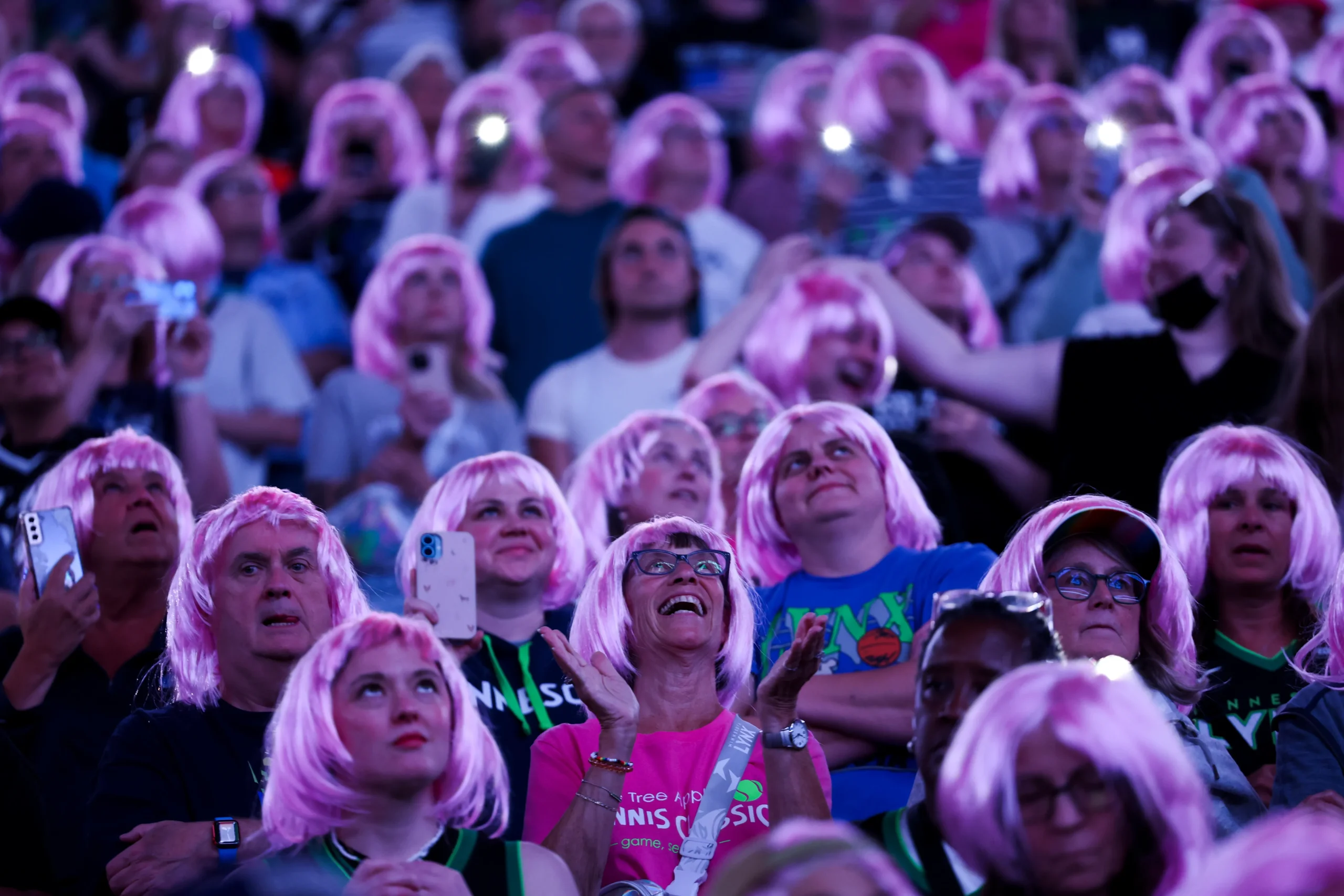
In 2026, opportunities to truly feel good about your social media feed are few and far between. But on the night of Aug. 25, it was filled with two things in particular: Dolly Parton and the Minnesota Lynx.
These are two great American institutions that have remained near the top of their respective fields for longer than most of us can remember, yet have they ever been discussed together? When two truly great things come into your life, don’t you have an obligation to bring them together? Back in 1928, H.B. Reese didn’t get a bunch of chocolate and peanut butter and then decide they were better off apart. So into the breach we go…
Dolly died on Tuesday at the age 80, following a lifetime of writing and singing about women. Women who endured disappointment, who never surrendered their independence, who worked without recognition, and who left familiar places in search of something larger. She sang about resilience, ambition, loyalty, reinvention and the power of being underestimated. Any of this sound familiar?
So, in celebration of her amazing life and seemingly endless catalog, we present to you the Minnesota Lynx, according to Dolly.
Napheesa Collier: “Eagle When She Flies”
While some Dolly songs may seem like better fits on their face, none capture the totality of Napheesa Collier as completely as “Eagle When She Flies,” a song about the different forms strength can take in a woman – softness without weakness, vulnerability without surrender, grace that allows her to rise above all that tries to keep her down.
Collier has never needed to dominate the conversation. Her game is similarly understated. She rarely looks rushed, rarely appears overwhelmed, and can tear teams apart without the need for theatrical flourish. You’ll think she’s having a quiet game and then look up to see a 25-9-6-3-3 stat line.
Since her return post-pregnancy, Collier has also become much more than Minnesota’s best player. She is the franchise leader, an entrepreneur, and a key voice shaping the future of women’s basketball. She may carry herself quietly, but she has never been meek. Her voice is so much louder than its volume.
A simpler choice here may have been “Best Woman Wins,” but “Eagle When She Flies” best captures the whole of Collier: composed on the ground and nearly impossible to reach once she rises.
Olivia Miles: “Girl in the Movies”
In “Girl in the Movies,” Dolly sings from the perspective of someone imagining a bigger life for herself. She doesn’t just want to watch someone else up on the screen. She wants to step inside and live the story herself.
Olivia Miles didn’t need much time to make the WNBA her own personal movie.
As the second overall pick in the 2026 WNBA Draft, Miles came into the league with a lot of expectations and then immediately exceeded every one of them. Instead of spending her rookie season learning and growing into a supporting role, Miles leapt onto the screen as a Star with a capital S.
Back in June, Cheryl Reeve joked, “We thought for sure she’d be a really good backup point guard if we needed one.” Fast forward two months later, and that “really good backup point guard” is a lock first-team All-WNBA selection and legitimate MVP candidate.
While “Wildflowers” captures the story of her being given room to grow and blossoming immediately, “Girl in the Movies” feels right for a player who didn’t just join the show but immediately became one of its leading characters.
Natasha Howard: “Here You Come Again”
Sometimes the most obvious answer is obvious for a reason.
Natasha Howard returned to Minnesota this offseason after helping the Lynx win it all nearly a decade ago. At first glance, the reunion seemed like a nice little nostalgia story: a respected veteran returns, bringing a bit of experience with her.
Instead, she immediately became one of the most productive players in the league, earning a starting spot in her first All-Star Game since 2022. This didn’t turn out to be a ceremonial homecoming or a beloved former player just stopping by to relive old memories. Howard returned and immediately began creating new ones.
“Old Flames Can’t Hold a Candle to You” would have worked here too and may have been a bit more fun, but the central fact of Howard’s season remains, thus making “Here You Come Again” fit better.
Here she came again, and somehow, she was even better than we remembered.
Kayla McBride: “Baby I’m Burnin’”
This one doesn’t require any high-level literary interpretation.
When Kayla McBride gets hot, she absolutely burns.
She requires less daylight than anyone else in the league. One screen, one moment of separation, and she’ll quickly get you a much-needed three. Then she’ll string together another, and another. Next thing you know, a close game is out of reach before the other team even realizes it’s all on fire.
As we discussed earlier this year, McBride’s been doing this for more than a decade, but that longevity hasn’t dulled the danger. She remains one of the league’s most feared shooters and has shown she can still completely take over a game, best evidenced by her 43-point, WNBA record-setting outburst on Aug. 9.
“9 to 5” (don’t worry, that one’s coming) would recognize her unbridled professionalism and all the work she’s put in to stay this good for this long, but when you watch McBride go on heater after heater, “Baby I’m Burnin’” is the only real choice.
Courtney Williams: “Two Doors Down”
Some players give you scoring. Others give you defense or rebounding. Courtney Williams gives you atmosphere.
“Two Doors Down” captures the irresistible energy of a party that becomes increasingly difficult to ignore. Music is playing, people are laughing and, before long, standing on the outside is no longer an option.
Since 2024, Williams has brought the party to the Minnesota Lynx.
She plays with joy that fills the arena. She talks, she laughs, she celebrates, she talks some more. She carries herself in a way that makes you realize – basketball isn’t just something she’s really good at, it’s also the most fun thing she could be doing (okay, after watching All-Star Weekend, maybe second-most).
When that midrange starts falling, her team gets a little bolder, the crowd gets a little louder, and even a random Tuesday can start to feel like a block party.
That energy shouldn’t be mistaken for a lack of seriousness. Williams competes fiercely, rebounds like she doesn’t realize she’s only 5-foot-8, and has developed into one of the league’s most dependable playmakers. A Courtney Williams party only works because she handles her business before turning up the music, especially when that party’s happening in Cheryl Reeve’s house.
“Straight Talk” (you can probably guess who’s getting that one) would also work, as Williams rarely hides what she’s thinking. “Why’d You Come in Here Lookin’ Like That” would cover the tunnel fits and hair. But “Two Doors Down” captures something larger.
Williams doesn’t just join the party. She brings it with her.
Nia Coffey: “9 to 5”
While nobody in the W actually works from 9 to 5, the spirit of Dolly’s working-class anthem “9 to 5” perfectly fits Nia Coffey.
Every contender needs that player whose value is greater than their usage rate. The player who defends multiple positions, rebounds, spaces the floor, makes the extra pass, and whose main focus is doing the work to make her teammates flourish.
That work is as essential as it is easy to overlook.
You don’t need to give Coffey a bunch of isolation plays for her to affect the game. She can help you win without scoring a point, but when the ball does find her, she knows exactly what to do with it.
“The Bargain Store” would make sense given the value the Lynx have gotten from one of their most modest veteran contracts. “Together You and I” would emphasize the way her game connects the pieces around her.
But ultimately, Coffey is the Lynx player who best represents the unglamorous hard work necessary to create a true championship contender.
Dorka Juhász: “Light of a Clear Blue Morning”
Dorka Juhász’s 2026 campaign has required a lot of patience. A lot.
After missing the entire 2025 season, her much-anticipated return this summer was delayed by a foot injury and still hasn’t quite taken flight.
“Light of a Clear Blue Morning” is about reaching the other side of a difficult period and finally being able to see possibility again. That makes it fitting for Juhász, even if her return hasn’t instantly restored all that was interrupted.
At her best, she gives the Lynx size, passing, and a frontcourt skillset they aren’t going to find anywhere else on the roster (at least not post-Emma Čechová injury). Her progress may be coming slowly, but every appearance represents another step toward reclaiming the form that made her the youngest EuroLeague MVP in history.
While “Try” would have emphasized the attempt to get it all back, “Light of a Clear Blue Morning” leaves room for something more hopeful — the possibility that the best part of that journey is still ahead.
Maya Caldwell: “The Seeker”
Maya Caldwell’s WNBA career has been defined by the search for a permanent home.
She’s moved between teams and between roles, constantly trying to prove she belongs in a league where really good players often remain on the fringes. Minnesota acquired her for essentially nothing right before the season began, giving her another opportunity to turn uncertainty into something stable.
The central longing of “The Seeker” is for direction, answers, and a place of fulfillment, which perfectly fits the life of a professional athlete searching for the right spot.
When Caldwell enters a game, Cheryl Reeve’s depending on her to defend like crazy, grab a few offensive rebounds, and hit a few open shots. For players living on the rotation’s edge, dependability can be the difference between finally finding a home and once again landing on the league transaction page.
“Starting Over Again” would cover her last-minute move from Portland, but for now, Caldwell remains the seeker, hoping that Minnesota is where she finally finds what she’s been looking for.
The Rest of the Playlist
So, we’re quite a few words in and not everyone has a big enough role to warrant a full verse, but Dolly’s catalog still has a little something for everyone, even those currently outside the main rotation.
Chloe Bibby: “Shine” — Bibby’s early opportunities have been limited, making every appearance an audition. A path is there to work her way into the rotation, but to do so, she’ll need to shine in every opportunity she’s given.
Antonia Delaere: “Blue Smoke” — “Blue Smoke” is a song of journey and departure, fitting a player whose career has spanned numerous countries, teams, and leagues before finally bringing her to the WNBA.
Anastasiia Olairi Kosu: “Wildflowers” — Since Kosu is one of four players left from last year’s squad, it’s easy to forget she’s only 21. While her minutes have been extremely limited of late, the Lynx can’t wait to see how she’ll ultimately grow with time.
Eliška Joklová: “Big Dreams and Faded Jeans” — Joklová came to Minnesota from the Czech Republic with WNBA ambitions but no guarantee of a permanent spot. She’s spent her rookie year near the edge of the roster, but those dreams remain big even when the opportunities are brief and the road ahead uncertain.
Liatu King: “Try” This season, the Lynx have waived King, brought her back, given her a standard contract, and then moved her into a player-development spot. The W doesn’t guarantee that persistence will be rewarded, but King keeps coming back whenever opportunity appears.
Bonus Track – Cheryl Reeve: “Straight Talk”
Could it have really been anything else?
Cheryl Reeve has won four titles, built and rebuilt multiple contenders, and established herself as one of the best coaches in basketball history, yet her accolades often aren’t the first thing people think of when they hear her name.
Whether it’s a questionable foul call, a defensive breakdown, or a hot-button social issue, Reeve has never been one to keep her opinions to herself.
Dolly built much of her public identity around delivering hard truths with so much wit, warmth, and heart that she remained one of our last universally beloved public figures. Reeve has never seemed particularly interested in universal affection, and while she has Dolly’s wit, she can sometimes waver on the warmth.
But there is never any doubt about Reeve’s heart. It reveals itself through her love for her players, her relentless promotion of women’s sports and her willingness to use her platform for vulnerable and marginalized communities targeted by discrimination.
The Lynx: “Together You and I”
No individual song — or weird collection of basketball comparisons — can adequately summarize Dolly Parton.
Her rhinestones, towering hair, and larger-than-life personality made her instantly recognizable, but the substance beneath it all made her an American icon. She understood struggle without romanticizing it, celebrated ambition without apologizing for it, and wrote women as complicated people full of tenderness, anger, doubt, desire and extraordinary strength.
That’s why her songs are so adaptable, even to an exercise such as this. They’re specific enough to feel personal and universal enough to belong to everyone.
The Lynx will play their final game before the FIBA World Cup Break on Sunday. They’ll return with only a handful of games to prepare for the playoffs. Along the way, there will be hard work, laughter, disappointment, and opportunities to begin again.
We love sports for all those reasons. At their best, they compress the struggle and joy of ordinary life into something we can experience together.
And that’s why we loved Dolly. She spent a lifetime writing us songs that capture it all.
Leave a Reply