
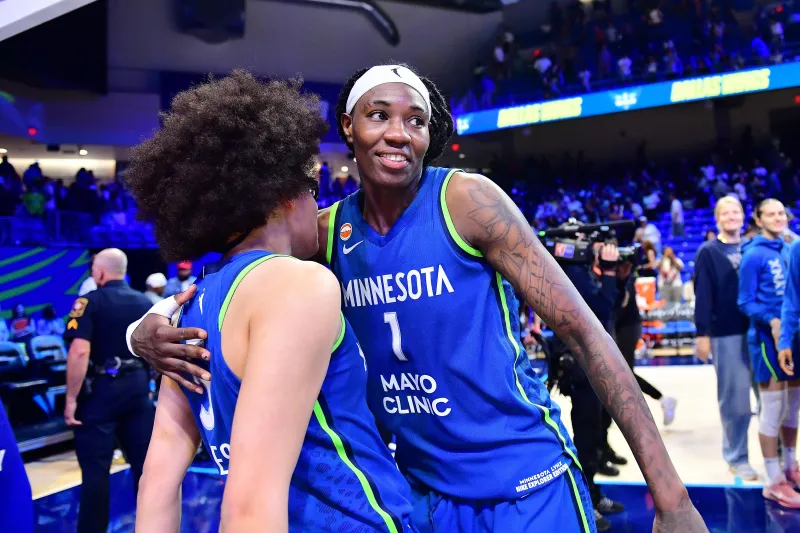
The week of April 11 was a dark one throughout Lynx Nation. If you happened to pop in on social media at nearly any point that week, no one would blame you for coming out convinced that 2026 season was over before a single game was played.
The opening day of free agency came and went, with Minnesota doing … nothing. We all had to just sit there and watch while the rest of the league emptied its wallet and nearly every player we coveted (remember balloon-gate?) flew off the board. All of Minnesota’s rivals seemed to be getting dramatically better. Meanwhile, Lynx fans sat there refreshing timelines and watching half of the rotation leave town, while many thought the organization was just sitting there watching it happen.
When movement finally came on day two, the reaction wasn’t much warmer. Re-signing Courtney Williams and Kayla McBride, adding free agents Natasha Howard and Nia Coffey did not move any needles after the silence of the first day of free agency. Then came the WNBA Draft, where the entire fanbase seemed to desperately want a true post presence in either Lauren Betts or Awa Fam. Instead, the Lynx went with point guard Olivia Miles with the second pick.
RELATED: Olivia Miles is Ready for Her ‘Welcome to the League’ Moment
Then, on top of all of that, the week closed with Napheesa Collier signing just a one-year extension, creating a near-panic that the franchise centerpiece might have one foot out the door. In Cheryl we Trust was definitely taking some hits.
From Panic to Perspective
A handful of games into the season, however, the vibe around this roster feels dramatically different. The biggest reason is simple: this team looks far more cohesive and thoughtfully constructed than people initially gave it credit for.
Even with Collier and EuroLeague MVP Dorka Juhász still out indefinitely with a foot injury, the Lynx have looked competitive, organized and — until Emma Čechová went down in the third game — surprisingly deep.
The roster questions that dominated the offseason haven’t disappeared entirely, but many of those additions that felt underwhelming in April suddenly made a lot more sense once tossed into Reeve’s system.
Why it All Makes Sense
Miles already looks like one of the best young point guards in the league – and at times, simply one of the best point guards period.
Her ability to control tempo and create passing windows has transformed the Lynx offense overnight, and — as addressed in a piece earlier this week by our own Mitchell Hansen — her fit alongside Courtney Williams has been far smoother than expected. Instead of clashing stylistically, the two have complemented each other perfectly, with Williams able to play more naturally off the ball while Miles controls tempo and creates advantages.
Some of the passes have been downright ridiculous, drawing comparisons to Chelsea Gray and even Magic Johnson. While those comparisons may ultimately prove premature, the excitement behind them is understandable. Miles doesn’t just look talented; she looks like someone capable of completely changing the ceiling of an offense, especially once Collier returns. Minnesota may still eventually need more frontcourt size, but it’s already become obvious why Reeve prioritized playmaking over another developmental big.
Meanwhile, Howard may be the clearest example of how quickly offseason narratives can shift. The initial perception was of a declining veteran far past her prime. To be fair, after the opener against Atlanta, those concerns didn’t exactly disappear. But ever since, Howard has looked like the player Minnesota clearly envisioned. Her chemistry with Miles in the pick-and-roll has developed almost immediately, providing a much-needed reliable interior scoring option. While the turnovers and free throws are frustrating, she has shown she can still finish efficiently around the rim, run the floor and punish smaller lineups inside.
Then there’s Coffey, who already looks like the quintessential Reeve-type player. She defends multiple positions, moves the ball quickly, rebounds, spaces the floor much better than expected, and understands how to play without needing touches. Every good Reeve team has had players like this – veterans who don’t dominate headlines but stabilize lineups. Coffey has immediately looked like one of those pieces.
The early contributions haven’t stopped with the headline players, either. Maya Caldwell — acquired for almost nothing before the season tipped off — has provided valuable wing depth, a physical perimeter defense, and professional minutes off the bench. Antonia Delaere — a 31-year-old WNBA rookie — has looked poised, skilled and already has the fanbase clamoring for more minutes.
The biggest revelation, though, was Čechová. Before suffering an ACL injury that ended her season, Čechová looked like an absolute steal. The 21-year-old rookie immediately flashed mobility, touch, instincts and a comfort level that was a true rarity for a young player with her size. Losing her hurts, as she was giving the team huge minutes and had the look of a potential star. Čechová also represented something else people missed in those early evaluations: Minnesota’s confidence in its own talent identification.
Unfortunately, her injury was a wake-up call that this roster still has real, immediate limitations. Minnesota’s depth in the frontcourt has become far shakier while waiting for Collier and Juhász to return. But that concern doesn’t erase what has quickly become clear through the first stretch of the season: this roster makes far more sense than many people initially believed.
The Vision is Coming into Focus
A lot of the offseason panic came from focusing on names instead of evaluating fit.
The fans wanted stars. Reeve built a rotation.
The fans wanted splash. The Lynx prioritized function.
And now that the games have started, the vision behind those moves is becoming easier to see.
The most encouraging part is that this group already looks capable of surviving until the stars return. If the Lynx can stay at or above .500 while Collier and Juhász work their way back, this team’s ceiling changes significantly. Suddenly, Minnesota’s not just scrappy and competitive — it starts looking like a roster with the versatility, depth, and chemistry to make legitimate noise in the playoffs.
That possibility felt difficult to imagine during the panic of opening weekend.
But now as the games have begun, it feels very real.