
With the first round of the NBA Playoffs in the books, eight teams remain in the pursuit of a league championship.
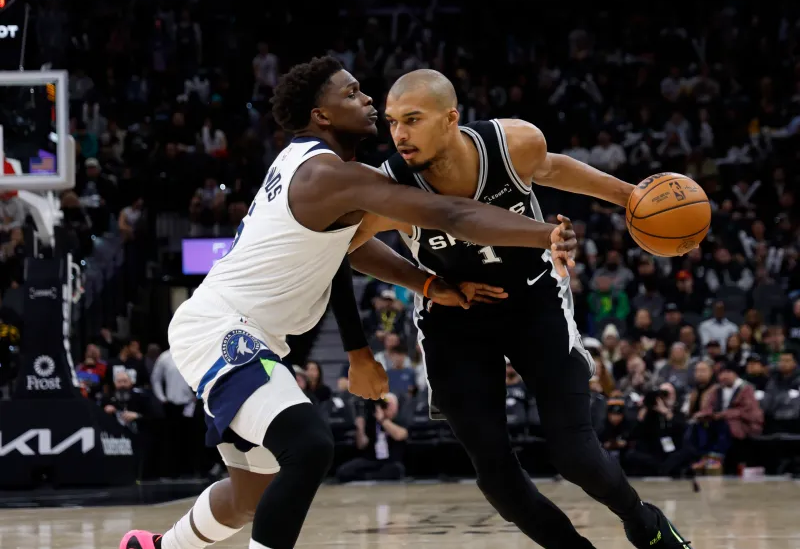
Two of those teams are the Minnesota Timberwolves and San Antonio Spurs, who will battle it out in the best-of-seven Conference Semifinals with a trip to the Western Conference Finals on the line.
Sixth-seeded Minnesota is coming off of an impressive 4-2 series win over the Denver Nuggets, while second-seeded San Antonio is coming off of convincing 4-1 series win over Portland. Oh, and did we mention, Anthony Edwards is somehow making his return.
How do these two teams stack up against each other? Let’s find out!
Head to Head Matchup
All-Time Head-to-Head: Spurs over Wolves 96-46
Playoff Head-to-Head: Spurs over Wolves 6-2 (San Antonio owns 2-0 series advantage)
2026 Season Head-to Head: Wolves over Spurs 2-1
Rankings Overview

Offensive Gameplan
What to Know About Minnesota’s Offense
Minnesota has a great and simple offensive identity: paint touches. The Wolves made it a point last series against Denver to dominate in the paint. The coaching staff did an incredible job of identifying the Nuggets weaknesses, attacking it with a variety of actions, and then adjusting to their adjustments.
Throughout the regular season, there was always talk about the process being there — it just lacked consistent execution, focus and attention to detail throughout the 82 games. There is always debate about Finch’s offense, but the beauty of Finch’s offense is the simplicity and the understanding of attacking weaknesses and letting the players figure it out. You saw the inverse of this from the Nuggets offensive side last series — which would you rather have?
Trust(ed) the process.
Minnesota’s Offensive Strategy
- Pull Wemby away from the paint: Similar to the game plan during the regular season, actions where the Wolves would pull the big up and play from there are most effective. The only difference in this matchup is that you have a freak of a defender in Victor Wembanyama who can guard every position and can play two at the same time. Like Rudy Gobert, but with a longer wing span and higher vertical.
- Find ways to get it to the paint at a high volume: This is the goal for every team, but the struggle is always trying to find the most efficient way to get there. The Wolves thrive when they can get to the paint, collapse the defense and make the right decision from there. They have been doing that at a great level this playoffs (fifth in assist-to-turnover ratio).
- Crash the glass at a high level: Against great defensive teams, getting as many possessions as possible helps your chances. Crashing the glass will help with this and the Wolves have found success with tip-outs and second chances this playoffs
What to Know About San Antonio’s Offense
Side story: When I was in middle school and high school, when we would get to playoff time, the Spurs were my team to watch. My dad and I would watch almost every Spurs game (that was our playoff team since the Wolves weren’t ever in it). This was the Tim Duncan, Tony Parker, Manu Ginobili era — The Beautiful Game Spurs.
Now this current Spurs era is very different. Still incredibly smart and they rely on cutting and reading, just a lot more downhill. A big reason for that is their superstar center Wembanyama who is a lob threat combined with three-level scorer, which makes it a nightmare for teams to match up.
San Antonio’s Offensive Strategy
- Get downhill to the paint: Similar to the Wolves, try to find the weak part of the defensive shell and attack it downhill over and over. Usually this starts with a semi-transition, top of the key action.
- Force switches: Like discussed above, the goal of this style of offense like the Wolves is to force switches to create mismatches and advantages.
- Break tight coverage with off ball entries: The Wolves are known for their point of attack defense, normally with Jaden McDaniels pressuring as soon as you cross the halfcourt line. They do this to force east-west movement instead of north-south. The Spurs could try to start with off-ball entries (actions that get the defense moving like screens, handoffs, etc.) to alleviate some of that pressure and to create gaps downhill.
Defensive Gameplan
Minnesota’s Defense
The patented Chris Finch defense was on full display against the Nuggets in the first round, which is a great sign. Finch said earlier in the year that the team needed to focus on their defensive identity and we saw the true identify last series — one that is tough and forces teams to uncomfortable spots.
This is a good sign, as this Wolves team actually defended this Spurs team well this season regardless of the inconsistency. As discussed throughout the last series, the Wolves just have a ton of levers to pull and it is mostly on the defensive end. It will all come down to if they can contain the Wembanyama roll, which will be a fun chess match.
Minnesota’s Defensive Strategy
- Limit paint touches: Both teams play a similar style of offense. Looking to get downhill by punching gaps or using pick-and-roll/dribble handoff actions. Less side-to-side than Denver, however, it still comes down to making San Antonio take shots outside the paint and moving side-to-side for a lower percentage shot. Minnesota can do this by playing drop coverage and getting over screens efficiently — then not over-helping off drives if you are guarding off-ball.
- Contain the roll man: Denver and Nikola Jokic did not roll as hard in the first round. Wembanyama is going to do the complete opposite, and he will look to pop as well and take Gobert off the dribble more effectively. The Spurs are incredible at hitting both Wembanyama and Luke Kornet, so Minnesota needs to play with active hands on that initial screen to slow the timing down.
- Play straight up: Just like Denver, you want to try to maintain your matchup. You especially don’t want to get a switch on Wembanyama. But, the Wolves do have the personnel to do it. You didn’t want to switch against Denver because Jokic is elite at reading and finding slip. But the Spurs are also great at cutting (second in league in points per possession on cuts during regular season). Portland did a nice job of taking this option way from San Antonio in the opening round.
San Antonio’s Defense
With the Spurs defense with Wembanyama on the floor, the goal of this defense is to apply strong ball pressure, prevent straight line drives, and Wembanyama will look to prowl the paint.
Honestly, this defensive strategy is almost identical to the Wolves with Gobert. The difference is the age of that anchor paint defender. Both are playing defense at an incredible level. However, Wembanyama currently has much more range in his ability to block shots which gives the Spurs a huge advantage and helped make them a top three defense in the league this year.
San Antonio’s Defensive Strategy
- Limit isolation: The Wolves are most effective when they can do two things: create a mismatch and take advantage of that mismatch by attacking and finishing or attacking and finding the open player. The Spurs will try to limit that by staying attached to matchups and contain drive to force midrange.
- Stay attached: See above. Limit switches by probably going drop coverage to slow down isolation opportunities and one of the most effective parts Minnesota’s offense with the spot up.
- Create turnovers: If the Wolves don’t turn the ball over, they are very efficient. But they are a team that is known to turn it over a ton. They will look to play with super active hands like Game 5 of the Denver series.
Stats and screenshots provided are courtesy of wolfwisestats