
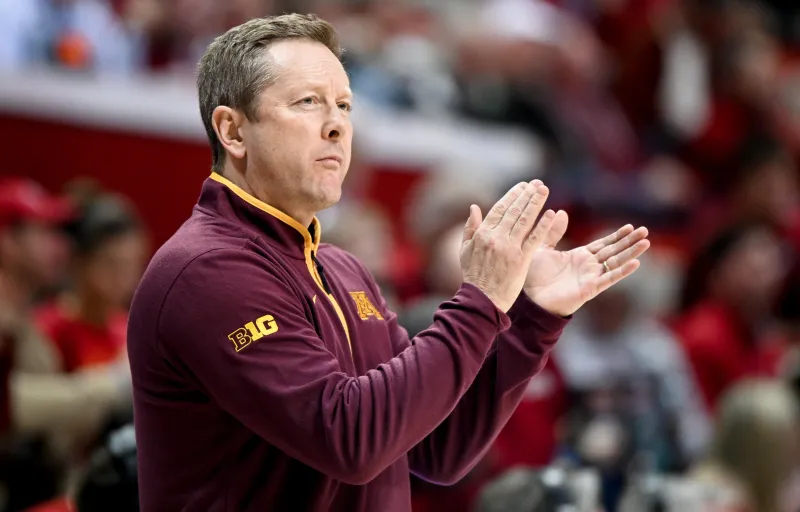
Niko Medved’s first year at Minnesota was flawed in some ways, but a success in many others. The theme of the year was injuries as the Golden Gophers lost two starters before the calendar flipped to December. The final blow was forward Jaylen Crocker-Johnson going down with a foot injury causing him to miss the final month of the year.
One of the positives that came out of the injury-riddled 2025-26 season was confidence that the Gophers have their coach of the future. Medved’s coaching chops were on display nightly as the Gophers battled, won games down the stretch and finished 11th in the final Big Ten Conference standings.
After a full offseason to retain key players and fill gaps in the roster, the 2026-27m Gophers men’s basketball season is starting to take shape. That roster will be challenged nightly in the Big Ten as Minnesota plays some of college basketball’s biggest brands and toughest opponents.
Let’s take a look at where the 2026-27 roster stands after returners committed, portal additions have been added, and with a fresh crop of freshmen set to join Minnesota.
Returning the Core
The Gophers quickly received commitments from all five players eligible to return to Minnesota. Starters Isaac Asuma, Bobby Durkin, Crocker-Johnson, Grayson Grove and the lone major bench player, Kai Shinholster, all will return next season. The only other players to play meaningful minutes during the Big Ten season, Langston Reynolds and Cade Tyson, are out of eligibility.
A transfer from Davidson, Durkin found his rhythm during the season and became one of the Big Ten’s best shooters. Durkin started 25 games and shot 39.2% from three, averaged 10.2 points and had a 2.3:1 assist-to-turnover ratio with a knack for nice passes to cutters. Another season with a consistent role, and knowing where his shots will be, should only allow Durkin to improve, though with more depth his total numbers may take a slight dip.
Asuma, a Cherry, Minnesota native, continued his improvement from year one to year two. He had ups and downs, but provided toughness in the backcourt and an ability to guard some bigger, strong Big Ten guards. Asuma averaged 10.9 points, and was second on the team in assists. He played and started in all 33 games, averaging the second-most minutes on the team behind Tyson. His three-point shooting needs improvement, as he only hit on 30% of his threes, but he showed an ability to hit floaters and get to the rim, which is vital to give shooters space. Asuma is also a solid free throw shooter and helped lock down a few wins by making it count at the line.
Crocker-Johnson will likely be a leader on next year’s squad. He is capable of making an All-Big Ten team next season, and he stepped up in some crucial moments last year. Reuniting with former teammate Kyan Evans should help as it creates continuity, familiarity for Crocker-Johnson. He averaged 13.4 points and 6.8 rebounds before missing the final nine games of the season. His shooting percentages are not where they need to be, but that could be due to playing out of position for much of the season after Robert Vaihola went down five games into the season. Crocker-Johnson shot only 41% from the field and 32% from three. He should look to get to the free throw line more often next season as he plays back in his traditional position.
Grove, an Alexandria, Minnesota native, contributed far more than expected after seeing him in the preseason. Grove became a reliable effort player whose hustle and grit earned him the respect of his teammates and fans alike despite playing heavy minutes, and often against much larger opponents. Grove was second on the team in steals and blocks, but his offensive game needs some work if he wants more time next season. He shot 25% from the free throw line a season ago and showed limited range, rarely taking or making shots outside of the paint. The free throw shooting is curious because that was not as much of an issue coming out of high school. He’ll be a core part of next year’s team, most likely as a back up post player.
One positive that came about because of all the injuries in 2025-26 was increased playing time for Shinholster in his freshman season. His offensive game needs work, but often it’s defense that takes the longest to translate for incoming freshmen. Shinholster was surprisingly solid on the defensive end. He’s a quick, athletic 6-foot-5 guard who, after another offseason on campus, should be a contributor next season.
Medved Gets His Floor General
In his final season at Colorado State, Medved nearly took his team to the Sweet 16, led by now Sacramento Kings wing Nique Clifford. But the starting point guard on that team was Kyan Evans. After limited minutes his freshman year, Evans came on strong his sophomore season in Fort Collins averaging 28 minutes, shooting 47% from the field and 44.6% from three. Evans parlayed that momentum into a lucrative NIL deal at North Carolina.
However, Evans, much like Tyson before him, found the grass wasn’t greener in Chapel Hill. Evans came in expecting growth, competing for an ACC title and more NCAA tournament games. He played four minutes in the Tar Heels’ first-round loss in the NCAA tournament to VCU. He averaged 17.6 minutes, shot 32.8% and averaged only 4.0 points as a junior for Hubert Davis’ team.
And much like Tyson, Evans is making the move to Minnesota hoping Medved can help resurrect his college career. So what should fans expect from Evans in his senior year in Dinkytown?
First of all, Evans is durable. He played 36 games each of his first two seasons under Medved at Colorado State, starting all 36 averaging 28 minutes per game in his sophomore season. At North Carolina last season, he again played in all 33 games and started in 17 of those contests. However, he averaged just 17.6 minutes in Chapel Hill, and it was really a tale of two half seasons. After playing 28 minutes in a 95-90 loss at Stanford on Jan. 14, Evans averaged 11.4 minutes He finished the season playing a total of 22 minutes over his final three games.
Evans struggled with his shooting for the Tar Heels. He was brought in as a reliable outside shooter, but finished the season shooting 30.5%. Compare that to his 44.6% the year before at CSU. What does that mean? Is it possible to regress like that in one season? Gopher fans may remember the three-point percentage dropoff of Gabe Kalsheur (41% his freshman year to 24.5% his junior season), but if there’s one thing we’ve seen in North Carolina, it’s that Hubert Davis’ system wasn’t for everyone.
Medved’s system creates quality shots. Players like Bobby Durkin consistently found open shots. Medved is excellent at getting after timeout (ATO) shots for Tyson, Durkin and even Crocker-Johnson. There’s a rhythm to his offensive system and players are comfortable knowing what shots to expect.
Though nothing is guaranteed, it’s easy to see a scenario where Evans finds that comfort level in Medved’s system again and produces at a high level. Evans may find the biggest challenges on the defensive end. The size and physicality of Big Ten guards could be a challenge, but playing alongside Asuma will allow Evans the chance to defend the lesser of opponents’ guards.
We could very well see Evans have a bounce-back season in 2026-27, including double-digit scoring and a return to form shooting 35-40% from three in the coming year.
From U of M to U of M: Two Wolverines transfer to Minnesota
Two former Michigan bench players will also join the Gophers in 2026-27. Medved is hoping for breakout seasons from 6-foot-6 guard Winters Grady and 7-foot-2 German product Malick Kordel.
Let’s start with Grady, as he appears to have the most upside and Gopher fans hope will replace some of the scoring production from the departure of Tyson. Grady comes in with some hype as a former four-star recruit. His playing time was limited his freshman year in Ann Arbor due to injuries. But the sharp-shooter came in with high promise and was a top 100 recruit.
Between Grady, Durkin and Evans, the Gophers have enough shooting to space the floor and put pressure on opposing defenses.
Kordel is a little more unknown. What is known is he is a HUGE body. At 7-2 and 275 pounds, Kordel should help anchor the middle for Minnesota’s defense. Kordel spent last season competing in practice against NBA Draft prospects and the core of Michigan’s national championship frontcourt, Aday Mara and Morez Johnson Jr. Those reps are valuable in being able to compete in the Big Ten against teams like Purdue, Michigan State, Illinois, and of course, Michigan.
Former MN Gatorade POY Returns Home
This move was speculated for months so it may not be a surprise, but the 2025 Minnesota Gatorade Player of the Year, Nolan Groves, left Texas Tech to return to his home state.
Groves is a strong, physical 6-foot-5 guard which should serve him well in the Big Ten. He was an elite high school scorer, but that didn’t translate in his lone season in Lubbock. Groves played in 23 games and averaged fewer than six minutes a game. His season highlight was earning the single-game Texas Tech freshman rebounding record with 16 boards in 27 minutes in the season opener. Groves also provided 13 solid minutes in the Red Raiders upset of Duke on Dec 20, 2025.
Much like Durkin and Tyson last season, Groves has potential for a breakout season under Medved. His makeup is reminiscent of former CSU Ram and current Denver Nugget, David Roddy. Roddy thrived as an undersized forward at Colorado State under Medved, attacking slower bigs and pulling them out to the three-point line, but also being strong enough to stand them up in the paint.
Villanova Transfers Adds Impact Wing
Malachi Palmer, a 6-foot-6 guard transferring from Villanova, was the final roster addition for the Gophers this spring. Palmer started his career at Maryland where he averaged eight minutes per game as a freshman.
Last season, he averaged 4.6 points and 1.7 rebounds in 18 minutes per game. Palmer’s shooting splits are encouraging, having shot 46.6% from the field, 35.9% from three and 76% from the free throw line. To cap it off, Palmer had 11 points in the Wildcats NCAA Tournament loss to Utah State.
This addition is another example of Medved finding big guards or wings who have the potential to shoot it at a high level.
Meet the Freshmen
Nolen Anderson, a 6-foot-7 four-star wing from Wayzata, was one of the state’s top recruits. Anderson played alongside Iowa State signee Christian Wiggins to create one of the best tandems in the state.
Anderson is reminiscent of Tyson, not only in his size, but how he plays. He can slash and cut, but also step out and shoot the ball. Of the three incoming freshmen, Anderson may have the best chance to play early if his defense is up to the challenge. However, the Gophers have enough depth at his position that he may not be required to play a whole lot.
One of the state’s premier scorers, Cedric Tomes from East Ridge High School, also joins Minnesota this year. Tomes was third in the state in scoring, averaging 30.7 points. He had to do a lot, and drew all the attention from defenses during his senior season. Tomes’ range is limitless and he’s not afraid to attack the paint.
Tomes’ size and defense are concerns. Most of the time East Ridge hid him on defense, but that could have been to save his energy on offense. Tomes is listed at 6-foot-2, but he looks shorter and has a slight build. He’ll need to build his strength to hopefully be the point guard in year two after learning from Evans. With more space to operate and more playmakers around him, Tomes could provide some highlight-worthy plays. His physicality is similar to that of Vanderbilt’s Tyler Tanner, and Gophers fans would fall over themselves if he turns into anything close to that.
The other incoming freshman is Chadrick Myopi, a 6-foot-10, 240-pound center from Irvine, California. Myopi gives Medved another big body presence in the middle along with Kordel. Size is definitely at a premium given the Big Ten powerhouses loading up on size. Whether Myopi will be able to contribute is another question. He began playing basketball six years ago and at times it shows. He’s going to be a project, but as they say, you can’t teach size, and he has it — along with a nice touch. Conditioning and quickness will be keys to him getting playing time in 2026-27. Both of next year’s centers are unproven, but have potential if they stick around for more than one season.
Final Notes
Max Lorenson, a redshirt freshman guard from Eden Prairie, is returning while Blake Nixon Jr., a freshman guard from Minneapolis, will round out next season’s roster.
On the surface it looks like a deeper roster, as 10 of the 15 players have played minutes at the high major level. Three of the remaining five are freshmen with promise.
The name of the game in today’s college landscape is retention of existing rosters and plugging holes via the transfer portal. Based on an 11th-place finish in 2025-26 with a depleted roster, Minnesota will likely finish somewhere in that range again in 2026-27. We’ll see how things come together in the summer and during the preseason. We will know a lot more come October when we get a look at this squad up close.
A lot of coaches go into the portal to add veterans and older guys who can help win today, but Medved’s approach is interesting. He’s added two upperclassmen in the portal, and brought in 3 players who will be sophomores. Medved appears to be betting on his returning players for the near-term and home run swings hoping to catch lightning in a bottle with the younger guys.
But if there’s one thing Gopher fans can count on, it’s that Minnesota will be prepared and well-coached.
Projected Depth Chart:
PG: Evans, Asuma, Tomes
SG: Asuma, Grady, Groves, Shinholster
SF: Palmer, Durkin, Grady, Groves, Anderson
PF: Crocker-Johnson, Grove, Palmer
C: Kordel, Grove, Myopi