
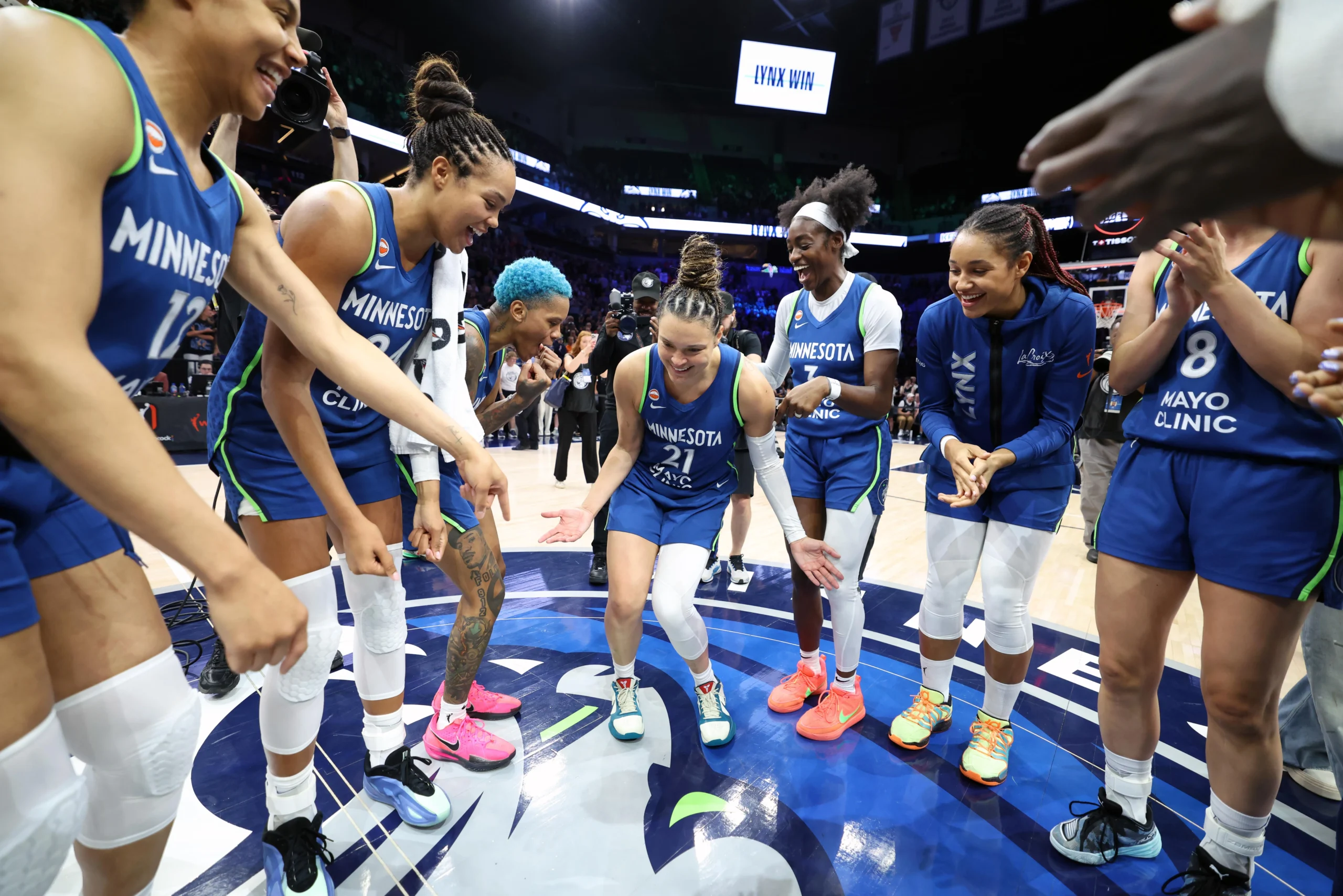
Three months ago, nobody knew what to expect out of the Minnesota Lynx.
They lost numerous key players via free agency and the WNBA Expansion Draft, leaving uncertainty both internally and externally as to what type of team would take the floor in 2026.
Some thought the team would be a borderline playoff team, floating around the .500 mark — especially until Napheesa Collier came back from surgery on both ankles. There were many questions about what the Lynx would look like this summer and what the direction of the franchise would be.
Well, those questions were answered in no time — and the outcome that has come about has been the biggest surprise of the WNBA’s 30th season.
Minnesota didn’t just get by without its MVP caliber of player in Collier. It surpassed expectations and became the top team in the league — a label that still holds true in the middle of August.
The Lynx are the best team in the WNBA, and have been all season long. And the scariest part of the other 14 teams in the league? The 2026 Lynx squad looks and feels a lot like a team that was the last one standing 10 seasons ago.
A Familiar Feeling
Of course, every team is different and every season is different. But this 2026 Lynx team has a familiar makeup and a familiar feeling about it that looks a lot like the squad that ended up winning the franchise’s fourth — and most recent — WNBA title in 2017.
That 2017 team was a special one — one that was filled with star power, fed off of its defense and felt like it would win every single time it took the court. With a dominant starting five, that Lynx squad took the fanbase, the state and league by storm. It had a chip on its shoulder after heartbreak from a year ago, looking like a juggernaut that would be one of the last teams standing in a revenge tour.

Fast forward to 2026, you get that similar feeling with Minnesota. And not just because some of the same pieces from 2017 are on this year’s team either on the court or on the sideline. This 2026 team is filled with star power, has been dominant on both ends of the floor and feels like a squad that you won’t be able to contain. And perhaps most importantly, it’s a team that is out to prove a point with a chip on its shoulder.
Both teams were and are battle tested, having experienced heartbreak in the postseason the season prior with something to prove in the current campaign. Both teams had a unique chemistry that clicked from the start of the season, with selfless personalities and play spread out throughout the team. And both teams were filled with some damn impressive talent that provides a headache to opponents to try and stop.
Comparing 2026 and 2017
When it comes to the makeup of both the 2026 and 2017 teams, each squad featured a well-balanced starting lineup with players who could step up at any moment and against any opponent when needed.
In 2017, you had Maya Moore and Sylvia Fowles leading the charge. In 2026, that is Napheesa Collier and Olivia Miles.
In 2017, you had Seimone Augustus that could step up offensively and also lock down opponents defensively. In 2026, that’s the Kayla McBride and her impressive two-way play.
In 2017, you had Lindsay Whalen and Rebekkah Brunson who were the glues and who did a lot of the little things that are so important on a championship team — also being capable of stepping up in key moments when needed. In 2026, that’s Courtney Williams and Natasha Howard (who was on both 2017 and 2026 teams, by the way).

These teams have similar pieces — all of which fit incredibly well together. They have that same cohesiveness and balance each others’ skillsets in impressive fashion. They have that championship DNA, which Minnesota hopes results in the same outcome at the end of the year.
But beyond the makeup of both teams nearly a decade apart, both teams displayed dominance in similar ways on both ends of the floor.
With 10 games left in the 44-game regular season in 2026 entering the Lynx’s game against Portland on Aug. 12, Minnesota is in the exact same spot and with the exact same record as it had during the 34-game regular season in 2017, carrying a record of 27-7.
Comparing the two teams through 34 games, the 2017 squad has an edge over the current team we see in 2026, but they share similar traits. They both relied on defense to turn things into offense on the other end of the floor. They shot the ball well, notably from three, and shared the ball well as a cohesive unit offensively. And they both took care of business with wide margins of victory per game.
| 2026 (34 games) | 2017 (34 games) | |
|---|---|---|
| Record | 27-7 (#1) | 27-7 (#1) |
| Offensive Rating | 114.1 (#2) | 108.5 (#1) |
| Defensive Rating | 103.3 (#3) | 94.4 (#1) |
| Net Rating | +10.8 (#1) | +14.1 (#1) |
| Margin Per Game | +9.0 (#1) | +11.1 (#1) |
| Field Goal Percentage | 48.5% (#3) | 47.8% (#2) |
| Three-Point Percentage | 39.6% (#1) | 37.0% (#2) |
| Effective Field Goal Percentage | 55.0% (#2) | 52.3% (#2) |
| Assist-to-Turnover Ratio | 1.69 (#3) | 1.45 (#1) |
| Opponent Points Per Game | 83.8 (#3) | 74.2 (#1) |
| Opponent Field Goal Percentage | 43.4% (#3) | 42.2% (#2) |
| Opponent Three-Point Percentage | 33.0% (#4) | 31.4% (#2) |
| Opponent Effective Field Goal Percentage | 50.0% (#5) | 46.6% (#2) |
| Opponent Assist-to-Turnover Ratio | 1.30 (#3) | 1.06 (#2) |
Of course, there is a lot yet to unfold in the 2026 season and regular season measurements mean nothing when the playoffs begin — especially if it results in no championship trophy when it’s all said and done.
But the makeup of the two teams feel very familiar, the vibes around the team feel very familiar, and the talent level on the 2026 team feels an awful lot like the last Lynx team we saw hoist the WNBA Finals trophy in 2017.
Leave a Reply