
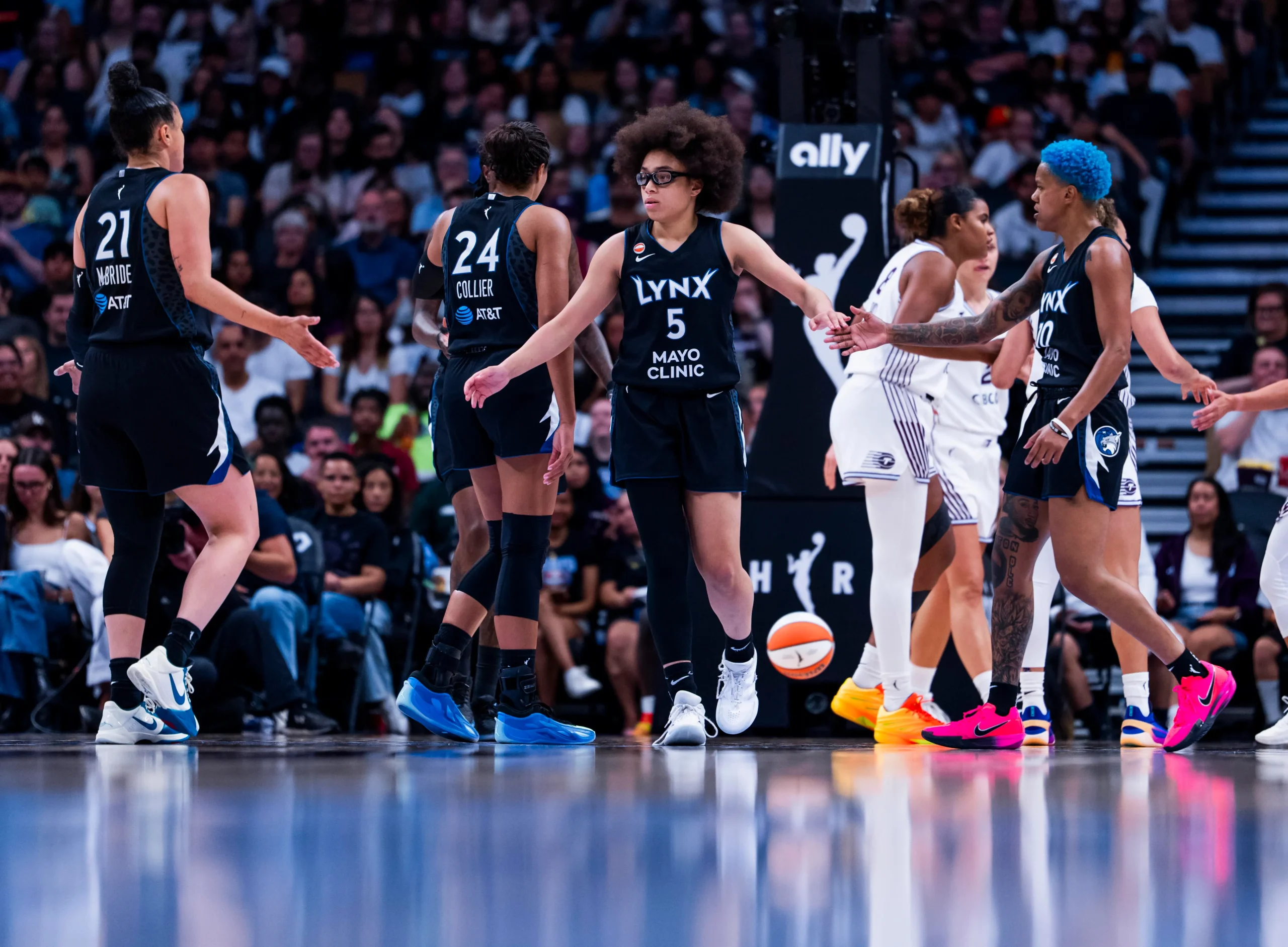
For some of the Minnesota Lynx, the upcoming World Cup Break will offer a rarity during a professional basketball season — two and a half weeks of rest.
But for several Lynx players, it will be anything but a break.
The WNBA will pause its schedule from Aug. 31 to Sept. 16 to accommodate the 2026 FIBA Women’s Basketball World Cup, which will be played in Berlin from Sept. 4-13. The Lynx could have up to four players in the tournament, including Napheesa Collier, who was named to the 12-player Team USA roster Thursday morning.
New acquisition Chloe Bibby has already been named to Australia’s final 12-player roster, Dorka Juhász is expected to be a centerpiece of Hungary and Antonia Delaere has been a long-time fixture for Belgium.
Olivia Miles, meanwhile, was not selected by Team USA. That leaves Minnesota’s two most important players on opposite sides of the world for the first few weeks of September: Collier will continue playing high-level basketball as she works her way back from offseason ankle surgeries, while Miles will receive a valuable opportunity to rest before her first WNBA postseason.
How each group uses the break will shape Minnesota’s preparation for the final week of the regular season, and ultimately, its pursuit of a championship.
The timing of it all leaves little room for recovery. Medal games will be played Sept. 13, the WNBA regular season resumes on Sept. 17 and concludes Sept. 24, followed by the playoffs beginning Sept. 27. Players of countries that reach the semifinals could play as many as six games in 10 days in the World Cup before flying back from Germany with only a few days to rejoin their teams.
Meanwhile, players who stay behind will have a rare and valuable opportunity to rest and recover from four months of basketball right before the postseason begins.
Besides Miles, Lynx players on that list include Kayla McBride, Courtney Williams, Natasha Howard, and Nia Coffey — all key veteran pieces who will surely welcome the rest. All four are in their 30’s and have handled heavy workloads throughout the season, particularly during Collier’s lengthy absence.
All of this makes the World Cup Break a potential burden and potential opportunity at the same time for the Lynx.
Bibby, Juhász and Delaere Appear Headed to Berlin
Bibby became Minnesota’s newest World Cup participant when the Lynz signed the Australian forward off of the Chicago Sky’s developmental list. While Bibby is unlikely to carry an especially heavy role for the Opals, Australia is a legitimate medal contender and could be there all the way to the end.

Juhász could face a considerably greater workload. She led Hungary through qualifying, averaging 18 points and nine rebounds, while getting named to the all-tournament team and helping Hungary qualify for its first World Cup since 1998. Hungary isn’t a medal favorite but could still advance deep in the tournament. And to be honest, Juhász may have the most to gain from the extra work. The Lynx would love to see her regain the form that led to her being named EuroLeague MVP prior to her foot injury and extended early-season absence.

Delaere also appears highly likely to represent Belgium, although the Belgian Cats haven’t formally announced their final roster. The veteran rookie guard has been part of Belgium’s national program since she was a teenager and played during the qualifying tournament in March. Belgium enters the World Cup as the reigning European champion and one of the teams most capable of challenging the United States.
Collier Faces a Delicate Balance
Collier’s Team USA selection requires a more nuanced evaluation than simply counting how many games she may play.
After undergoing surgery on both ankles during the offseason and just recently returning to the floor with the Lynx, sending her to a compressed international tournament immediately before the playoffs carries an obvious risk. The World Cup schedule is demanding and provides limited recovery time. Even if Collier stays healthy throughout the tournament, she’ll likely return to Minnesota just days before the regular season resumes.
The safest play would have been using the break for controlled workouts, treatment and recovery, but there is another way to look at it.
Collier missed most of the regular season and is still working her way back into full basketball condition. High-level international games will hopefully help her continue to regain timing, rhythm and confidence in ways practice can’t fully duplicate.

Team USA won’t necessarily need her to carry a heavy burden, either. With A’ja Wilson, Breanna Stewart, Aliyah Boston and Angel Reese also in the frontcourt, Team USA should be able to keep Collier’s minutes manageable. She’ll have the opportunity to continue playing meaningful basketball without being asked to produce 30-plus minutes a game.
This could create a productive balance for both Collier and the Lynx.
Ultimately, her World Cup decision may have been less about choosing between rest and basketball and more about finding the right balance of both. If she returns healthy and closer to peak form, the tournament could leave her better prepared for the playoffs than two-plus weeks of controlled workouts in Minnesota.
Miles will Receive a Valuable Break
While Miles did not make Team USA’s final roster, her breakout rookie performance surely forced USA Basketball into some uncomfortable conversations.
The Spectacle — or The Show, depending on your preference — has rapidly become Must See TV and is one of the main reasons the Lynx worked their way to the top of the standings without their best player. Her playmaking and ability to get to the rim gave her a legitimate case for selection.
Ultimately, USA Basketball chose a more established perimeter group that includes Caitlin Clark, Paige Bueckers, Chelsea Gray, Kelsey Plum, Jackie Young, Kahleah Copper and Rhyne Howard. While Miles is already good enough to belong on that stage, she simply didn’t have the national team history of the players selected ahead of her.

From a Lynx perspective, though, her omission could provide an immediate benefit.
Playing in the World Cup would have given Miles valuable international experience, but it also would have taken away the opportunity to rest and recover before her first WNBA postseason.
Miles has already carried responsibilities uncommon for a rookie. By the time the break comes, she will have played more games than in any prior college season, all while leading a championship contender and playing at an MVP level. Instead of adding as many as six World Cup games and transatlantic travel to that workload, she’ll have more than two weeks to rest and recover. And maybe most importantly, she’ll get two-plus weeks of Cheryl Reeve and Lindsay Whalen intentionally preparing her for playoff basketball.
There will be plenty of future opportunities for Miles to shine with Team USA. For the Lynx, having their rookie point guard rested and ready for the postseason may be more valuable right now than the international experience she would have gained in Berlin.
Minnesota Won’t Be Alone
While the World Cup may significantly affect the Lynx, their situation may not be the most difficult among the playoff contenders.
Las Vegas will be sending the biggest American group, with Wilson, Young and Gray all being named Team USA. In addition, Stephanie Talbot has already been named to Australia’s roster and Mai Yamamoto is expected to play a major role for Japan. If all five participate, the Aces would enter the final week of the regular season with much of their veteran core returning directly from Berlin. Wilson, Young and Gray will likely be playing through the medal games, while Talbot and Yamamoto also represent countries capable of extending their stays beyond the group stage.
Atlanta could face a similarly disruptive situation. Howard and Reese were selected by Team USA, Isobel Borlase has been named to Australia’s roster and Sika Koné could carry a significant workload for Mali. Allisha Gray was left off the U.S. roster and will receive the full break, but the Dream could still send four important players to Berlin.
Golden State’s World Cup contingent will likely be the most internationally concentrated. Gabby Williams, Janelle Salaün and Iliana Rupert are all likely options for France, while Cecilia Zandalasini should play for Italy. France is a medal contender, meaning Williams, Salaün and Rupert could all remain in Berlin until the tournament’s final weekend. Golden State will at least retain Veronica Burton, Tiffany Hayes, Kayla Thornton and Kiah Stokes, giving several veterans the benefit of the full break.
No contender, however, may have more players affected than New York.
Stewart was selected by Team USA. Satou Sabally (if finally healthy) and Leonie Fiebich are expected to lead host Germany, Marine Johannès should represent France and Raquel Carrera is a strong candidate for Spain. While Sabrina Ionescu was not selected by
Team USA, the Liberty could have additional French candidates in Pauline Astier and Marine Fauthoux. A conservative projection could still leave New York with five World Cup players. A more expansive one could push that number to six or seven.
Indiana and Dallas will send smaller but highly important groups.
Clark and Boston were both chosen by Team USA, meaning the Fever will send their primary creator and starting center while most of their rotation rests.
Dallas will send Bueckers to Berlin, while Alanna Smith has been selected by Australia. The Wings may lose only two players, but both are central to what Dallas does, particularly now that Smith has worked her way back into the starting lineup.
Washington may be positioned to benefit the most. Kiki Iriafen, Shakira Austin and Sonia Citron were all left off the Team USA roster, and the Mystics currently have no clear World Cup participants. That could allow one of the league’s youngest teams to use the break as an extended late-season training camp while the contenders ahead of them send major pieces overseas.
The Break Won’t Be Equal
The WNBA calendar calls Aug. 31 through Sept. 16 a break, but it will be anything but that for many of the league’s best players.
Some will receive treatment, individual development and more than two weeks without a game. Others will travel to Germany, practice with new teammates, and play up to six games against elite international competition.
For the Lynx, the divide is now relatively clear.
Bibby, Juhász, Delaere, and Collier are all likely heading to Berlin. Miles, McBride, Williams, Coffey, and Howard should receive a valuable opportunity to rest and recover.

The Team USA roster announcement could leave the Lynx better positioned than several of their primary competitors. Las Vegas will send three members of its championship core to Team USA, New York could have players representing four different countries, and Atlanta may lose four important contributors. Minnesota, meanwhile, will retain most of its veteran rotation along with the likely Rookie of the Year.
What is clear is that the World Cup won’t just interrupt the WNBA season — it will require teams to carefully balance rest, health, sharpness and team continuity.
The Lynx may be better equipped than most teams to absorb that uncertainty. Their veteran American core should receive valuable rest (and time to work with the league’s best coaching staff), while several international players could benefit from meaningful roles in Berlin — and Collier will hopefully continue to recover the conditioning and rhythm she lost during months of rehabilitation.
For Minnesota, the World Cup break won’t be inherently good or bad. Its ultimate value will depend on whether the players who stay take advantage of the rest, and whether Collier and her international counterparts return healthy, sharp and ready for a postseason run.
Leave a Reply