
The NBA moves fast. Blink and you go from taking in the NBA Finals, to new teams getting their — hopeful — franchise players in the NBA Draft, and the start of free agency and trades during transaction season.
And when the Minnesota Timberwolves have a General Manager as aggressive as Tim Connelly, you always have to be on your toes.
This article has been written and re-written hundreds of times throughout the past week-plus because, just when you wrap your head around one move, the next notification hits your phone that changes everything that you thought you knew. It’s been a wild ride the last week for Minnesota, so let’s take a second to zoom out and talk about each move it made that will have cascading impacts to this upcoming season and beyond.
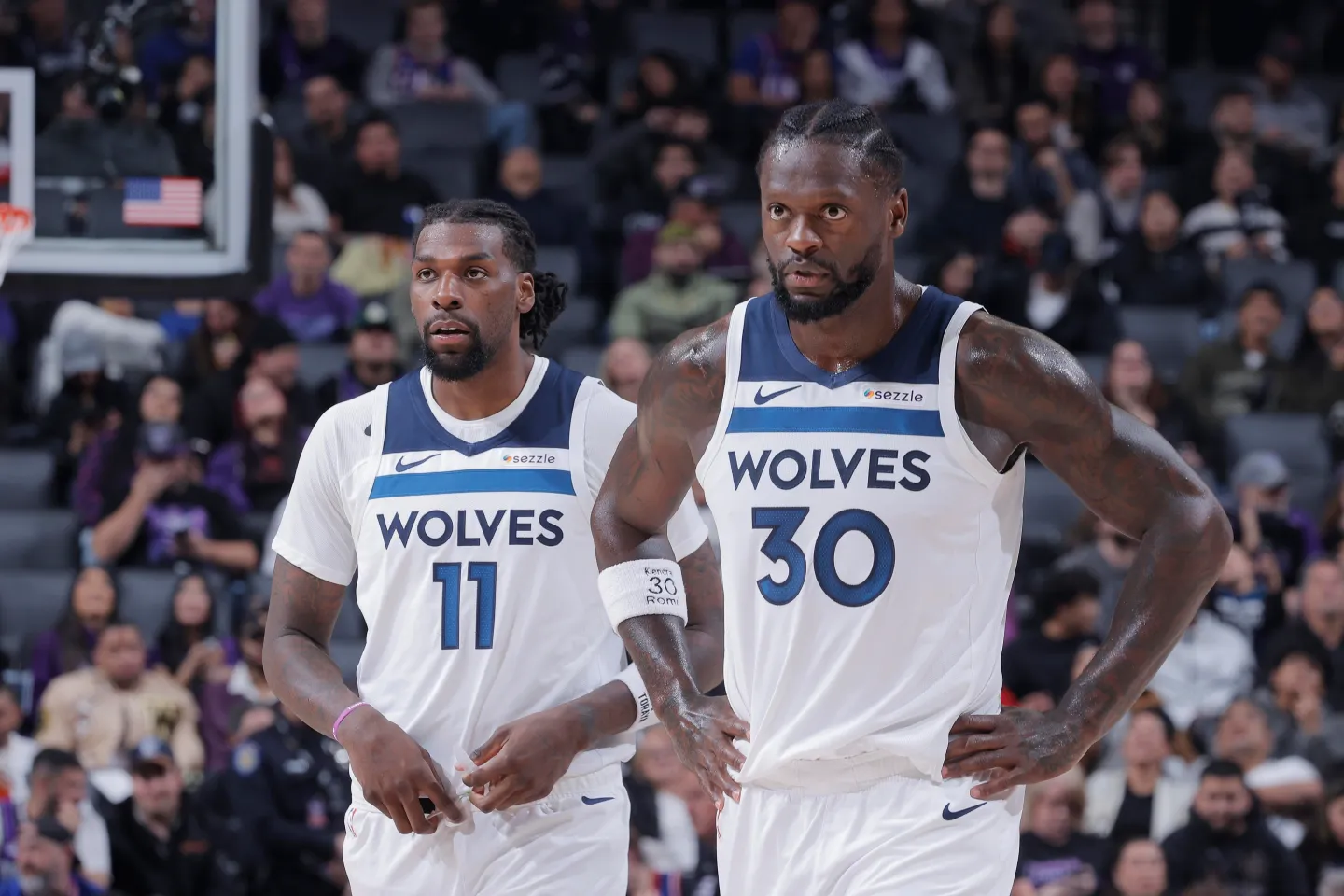
Julius Randle Traded to Brooklyn
The first in a long line of transactions came on June 22, late in the evening, when the Wolves dealt Julius Randle for… nothing? This type of trade is incredibly confusing to try to explain to your friends and family that fall more on the casual side of the fan spectrum, but still was important to the infrastructure of the Wolves roster. Minnesota traded Julius Randle and the 28th overall pick in this year’s draft to the Brooklyn Nets for the 33rd overall pick, which was one of the first picks of the second round. This is important to understand from a salary cap perspective.
The trade with Randle was a true salary dump. Minnesota traded him without taking back any salary in the deal. This did a few things — at the time that have since changed:
- Gave the Wolves true financial flexibility by dropping them below the aprons and the luxury tax line.
- Generated a $33 million dollar trade exception — where you can absorb a player that makes up to that contract number without sending out matching salary, but it hard caps you at the first apron.
- The 33rd pick comes with more flexibility on that contract rather than having the 28th pick. The 33rd pick’s base year one salary is $1.35 million, with the 28th pick’s base year one salary at $2.97 million.
At the time, it seemed like an important reset to give the Wolves a much needed ability to be able to roster build more freely. That also came with the promotion of Naz Reid into the starting power forward spot. But, as it goes, just when you reframed your thinking that Reid is the starting ‘4’ and figured out how exactly what a trade exception is — everything changed again.
Ayo Dosunmu’s Extension
About an hour after the Randle trade news dropped, Ayo Dosunmu’s extension was announced, a five-year, $112 million contract to return to the Wolves.
The $22.4 million average annual value came in a bit higher than most expected — it was easy to assume he’d fall somewhere between just above the non-taxpayer Mid-Level Exception (set at about $15 million per year, the contract that Nickeil Alexander-Walker and Donte DiVincenzo are on) and the low $20 millions. With that being said, here are some of the players making similar money to Dosunmu: Alex Caruso, Kristaps Porzingis, Shaedon Sharpe, Malik Monk, Christian Braun, Andrew Nemhard and Josh Hart, among others. This nets out to be last starter/sixth man type of money.
Dosunmu bursted on to the scene in Minnesota as a trade deadline acquisition, conitinuing his deadeye catch-and-shoot three-point shooting that made him desirable for the Wolves. His acumen in transition injected life into the Wolves bench unit and his ability to be a connector on the floor was sorely needed to bring the Minnesota roster together down the stretch. Most will remember his 43-point outburst in the game where DiVincenzo and Anthony Edwards both got hurt, when he single-handedly took down the Denver Nuggets in an insane game and showed more to his game that can be uncovered.
In order to turn this deal from at-market to a steal, Dosunmu will have to hit that level of play over the course of the contract. No, you cannot expect him to score 43 points a game, but it seems like every team has a player like Dosunmu on the roster. Along with this, his catch-and-shoot prowess along with attacking closeouts when the defense is in rotation, his want to get out in transition and his ability to create while not being the primary ball handler should slot in perfectly next to the newly acquired LaMelo Ball.
Wolves Draft Isaiah Evans and Trey Kaufman-Renn
After trading back a few spots in the draft thanks to the Randle trade, Wolves fans had to wait an extra 24 hours to see what rookies would be added to their team. They held the 33rd and the 59th overall picks in the second round, using them to take Duke’s Isaiah Evans and Purdue’s Trey Kaufman-Renn.
With the caveat of just starting tap in to these two as prospects over the last week or so, and catching a few full Duke and Purdue games throughout the season, Evans is very intriguing as a second-round flier. The brief overview is that he’s tall, he’s skinny, he doesn’t have extreme burst, but he can shoot the heck out of the basketball. The mechanics are smooth and he gets good shots up quick at an NBA speed, and he did it at a high level for two years at Duke. He shot 41.6% on 4.1 attempts per game his freshman year and 36.1% on 7.4 attempts per game his sophomore campaign.
This is a high-level college shooter that should excel at playing off of high gravity players and putting threes up at a high volume. Sound like a familiar context? He’s also 6-foot-6, so height isn’t a big issue as he projects as an NBA wing. His negatives as a prospect are the speed leaves something to be desired and he only weighs 185 pounds, so there are question marks of his ability to defend of NBA strength. Betting on shooting as an offensive skill usually translates better to an NBA context more than other offensive tools, so it will be interesting to track his progression as the season goes along for a team in need of catch and shoot three-point threats off of their big offensive engines.
Kaufman-Renn was a high production college big who spent his whole career at Purdue. His senior season, he averaged 14.2 points and 8.3 rebounds per game after averaging 20.1 points per game in his junior season. His size projects him as an NBA power forward at 6-foot-9, but he does lack NBA athleticism.
At this point in the draft, however, you’re taking shots on players that have one thing that you can point to that sticks out when looking at their profile. Kaufman-Renn’s is his college production. Averaging double-digits and up to 20 points per game in the Big Ten is no small feat.
Naz Reid and LaMelo Ball
This section is probably what you were looking for when you started reading, and maybe you skipped right to this part — no matter how you got here, this trade was …WOW.
At roughly 8:23 a.m. on June 25, Connelly and the Wolves yet again swung for the fences. They traded Naz Reid, a 2033 unprotected first-round pick, three first-round pick swaps in 2028, 2029 and 2030 and three second-round picks in 2029, 2032, 2033 for LaMelo Ball and Josh Green. This shocked the NBA, and more importantly Wolves fans, to their core.
Any conversation in the immediate aftermath about this trade has to start with an homage to Reid. We all know the story, but let’s tell it again anyway because of how special it truly is.
Reid went undrafted in 2019 when the Wolves picked up the phone to sign him as an undrafted free agent. He fought as the underdog for every single inch in the NBA. Year-by-year, he slowly but surely started to morph himself in the player we see grace the court today. The high flying, nifty handling and three-point bombing Big Jelly took Wolves fans by storm. As things started to turn for the better and Minnesota became more and more relevant in the West, Reid took leaps with the team. He became so beloved as Minnesota’s sixth man, that people claimed him as their icon. They got tattoos on their bodies, lined up to receive beach towels with his name on it and even honked at a local pizzeria sign to show their love and support.
Reid took Minnesota in as his own. Uttering his name became the symbol of hope for Wolves fans that made it out the other side of the dark days. Minnesota sports fans often feel overlooked, constantly being told that their market is too small and their weather is too cold that they don’t deserve great players. They’re underdogs, they’re overlooked, and yet they won’t ever stop. Reid embodied that spirit.
He will leave a lasting impact on all fans and the state of Minnesota, and the mutual love will not be forgotten anytime soon.
Now that the legend has been properly appreciated, the excitement that comes with this deal is palpable amongst Wolves fans. Reid is obviously painful to let go, and the 2033 pick is a real asset that Charlotte got. But of the three pick swaps, it is unlikely that two of them will be used because of the protections on them and the third may not be used either. The price of Reid and the 2033 first-rounder were real assets they had to risk, but it is hard to find a player that fits better next to Edwards than Ball while being a capable second option.
Judging the fit, it’s nearly perfect. Ball’s ability to be a playmaker for others, shoot at a high volume and high percentage, as well as create magic with the ball in his hands is exactly what has been missing next to Edwards for years. He’s able to make every read in the game because of his 6-foot-7 frame, and will provide a great release valve for Edwards on offense while also taking a lot of the table setting duties off of his plate. There are valid question marks about his availability — although in many of the years that Charlotte was clearly not trying to win, it has to be taken into account how many of those missed games were legitimate — his defense and his commitment to serious basketball 100% of the time, but the talent is undeniable.
For those that enjoy the advanced statistics outside of the in theory fit, Ball had a +9.9 net rating and a +11.6 offensive rating when he was on the floor for the Charlotte Hornets. This was for a team that when the calendar flipped to 2026 was one of the best teams in the NBA — period. Because Kon Knueppel and Brandon Miller did much better coming from off the ball, Ball had the ball in his hands a lot. He was the offensive centerpiece of that team and was relied upon to create for the knockdown shooters as well as the lob threats at the rim for a roster that had mostly rim rolling bigs. This should also help out Rudy Gobert on the offensive side to unlock that above the rim game. Gobert more activated on offense means that he is more locked in on defense, and should help the TWolves to play much better offense when Gobert is on the floor.
We can all picture the possessions against great defenses where Edwards starts the possession, receives a screen from Gobert where he is double teamed and then has to work so hard just get by initial pick-and-roll coverage, just to run into gap help and finally a rim protector that is laser focused on getting the ball out of his hands. How exhausting. With Ball on the floor, those teams will not be able to load up as much on Ant, because they will now have a guy that can punish that with his scoring and playmaking off the bounce. A great stat from the Pioneer Press’ Jace Frederick was that Kon Knueppel shot 9% better on catch-and-shoot threes when Ball was on the floor.
The defense is a real concern, as Edwards will have to tap into the 2023-24 version of himself on that end of the floor. If he doesn’t have as many playmaking responsibilities on the offensive end, it does stand to reason that he should be able to exert more energy on the other end. Ball also has the gift of height on his side, something that the likes of Mike Conley did not. The thing about Ball is that he does not have to be a defensive stopper, but he does have to buy in and find archetypes of players that he is good at guarding — similar to Conley always guarding the best catch-and-shoot player. He has the height to scale up and down to multiple positions, so finding his niche within the defense will be important in protecting him on that end of the floor.
It was a whirlwind of a week in Wolves land, and with free agency just beginning, the transactions are not over yet, Minnesota still needs a power forward to round out the roster and, if nothing else, you can expect them to be aggressive in that pursuit.