
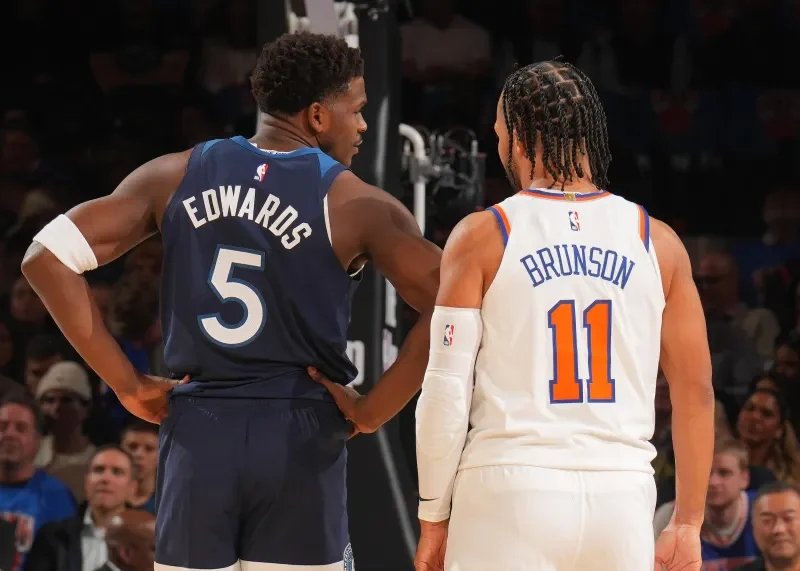
The long NBA season has come to an end, with the New York Knicks defeating the San Antonio Spurs in five games to claim the league crown. This is the time of year where the one team that surmounted the mountain gets to take their victory lap, while the other 29 teams recollect and come up with a plan to somehow, some way reach that same summit.
The Minnesota Timberwolves are one of those other 29 teams. While the season ended on a sour note, the pending offseason is shaping up to be one of the biggest for the Wolves in recent memory. There are expected to be new faces, and some of the returning ones will most likely have a different role than this last iteration of Wolves basketball. To be the best, you have to beat the best — and that starts with seeing what components made up the championship-caliber teams, as well as what you can do oppose those teams in your own unique way.
Before digging into the things that Minnesota should have up on its master whiteboard this summer, it’s important to make one thing very clear: There is no one, singular blueprint that a team has to follow to win a championship. In this era of parity in the NBA, with eight different champions the last eight years, each team has had their own unique team build and style of play that brought them to the top. That is simultaneously reassuring as it gives the Wolves hope in their core and what pieces they add to it in order to try to chase an elusive championship, while also being extremely difficult as there is not one tried and true method for Minnesota to follows to get to where it wants to go. But that’s the beauty of basketball.
With that being said, there are still plenty of things that Wolves fans and the team alike can take away from the epic five-game Finals series that closed out the 2025-26 season — both on and off the court.
Commitment to Identity
Identity is such a hot-button topic that every member of an NBA organization discusses constantly. Talk is cheap, living and breathing an identity is much harder.
One of the biggest things that the Knicks — along with every other champion over the last eight years — had was an unwavering commitment to a brand of basketball that made them special. There have been countless examples of this in the latest era of the NBA — and nearly every champion have had a different one. The Knicks were committed to doing the right thing on every possession while relying on Jalen Brunson to take them home. They gave themselves over to this identity, and all the players bought in to playing that style of basketball. Think of the number of random second quarter offensive possessions where the Knicks knew exactly the kind of offense they wanted to play to break down San Antonio’s Victor Wembanyama and get a good shot. When there was a substitution for the Spurs, New York immediately clicked into the offensive and defensive scheme that was needed to break that lineup down. While identities can range in their on the court tangibility, we all have a feeling when watching championship teams play that we can usually distill into a consistent theme that makes them the way they are.
This dedication to an identity is not unique to the Knicks. Think of the teams that have made the Finals or won the championship over the last few years. The Indiana Pacers had the quick-fire offense where they ran down the floor every possession. The Oklahoma City Thunder with a machine-like approach and physical defense. The Boston Celtics with their three-point dominant blender offense. The Denver Nuggets with their lethal two-man game that got a good shot on every possession. These are just a few of the recent examples of the idea of identity.
All of these teams we remember that made deep runs and either won the whole thing, or got as close as you can get, had a basketball identity that was sharpened over 82 regular season games and passed the test over and over again in postseason play. While the Wolves fancied themselves a “flip the switch” team — and to their credit did make good on that promise for at least a little bit in the postseason — the last two years, they have struggled to create and hone an identity. The age old adage of “you don’t rise to the occasion; you fall to the level of your preparation” rings true year after year, and it’s important to recognize that early to work on having it firing on all cylinders when the games matter most. While the pushback to this could be the Knicks of this year, who struggled for extended stretches during the regular season, there were still large samples of games that showed what New York’s potential could be. There’s beauty in the struggle, and the Knicks being willing to lean into that and work through it is a big reason why they hoisted the Larry O’Brien trophy this year.
If you were to look at the Minnesota roster right now, the biggest things that pops off the screen that could be shaped into an identity is strength and toughness. Looking at the alleged core of Anthony Edwards, Jaden McDaniels, Naz Reid and Joan Beringer, all of them have traits that are framed by those key words of strength and toughness.
Whatever you believe about what the Wolves’ identity should be — or maybe, more importantly, what Tim Connelly thinks it should be — every transaction that is made should be done with that in mind. We’ve seen plenty of different types of identities make it to the top and Minnesota has great pieces to be able to find and sustain an identity that works. Now the challenge is to forge it like those same teams that have hoisted that championship trophy.
Anthony Edwards and Jalen Brunson as Playmakers
First off, Brunson needs to be given his flowers for his performance in the Finals. While he did not have the most efficient series and had his poor moments as he struggled through the puzzle that is Wembanyama, he gave his best when it was required. The Knicks don’t snatch momentum in Game 1 and plant a seed of doubt that grew throughout the series without his clutch performance. They also don’t close out the series in Game 5 if he didn’t score 45 points and put the whole team on his back. The belief that everyone had in him to bring them home was special to watch.
While Brunson did it on the biggest stage — and it could be considered sacrilegious to compare anyone to him at this exact moment in time— there are a lot of similarities between how him and Anthony Edwards operate. They are score-first guards who use that gravity to get to their spots and put the ball in the hoop. That is zooming out a bit too far even for the liking of some, but the striking similarity was the playmaking that Brunson was doing was fascinating to watch throughout New York’s entire playoff run. Despite him being a killer in clutch time, and putting his team on his back when the games got tight as well as anyone in the NBA, the playmaking reads he was making were not extremely complex ones the majority of the time. Brunson made the simple plays when he needed. When the double teams came, he passed it to where the double came from. When the defense worked hard to get it out of his hands, he trusted his teammates to make the plays or get the ball back to him in a more advantageous position. He also had the killer instinct to take the big shots and the skill to make those shots.
We’ve seen Edwards have that same killer instinct and that same skill to make the shots. His clutch-time numbers in the regular season shot through the roof with the shotmaking at an all-time high. He has that aspect of the game in a great spot, and it should continue to get better as he gets older. The place that he seems to be lacking is the commitment to making those simple, correct plays. We can picture Edwards making a superhuman effort to make an insane, clutch shot over two defenders as the crowd erupts — but those plays are not sustainable for a grueling, four series grind when the games matter the most. Not all of it is his fault, Minnesota’s roster building has had some issues putting a great offensive infrastructure around him to the point where he feels comfortable making those plays and getting off the ball. But, Edwards also does have room to grow in the playmaking part of his game.
The great news is that Brunson was not necessarily super-computing like a Nikola Jokić or Luka Dončić. He was making those simple reads when getting blitzed, and used his scoring gravity to find those reads. Edwards could find a similar blueprint to getting to the point that Brunson reached in these playoffs. He is one of the most gifted scorers in the league, if he is able to make the simple, correct play more often — while having the personnel around him that can support that style of play — that will help him and the Wolves take leaps and bounds.
This isn’t necessarily a new topic, but it is encouraging to see that similar type of dominant scorer and playmaking off of that work at the highest level.
Being Happy for Karl-Anthony Towns
The final big takeaway from the Finals doesn’t have anything to do with teambuilding or individual players improving in certain areas — it’s to show some love for the guy that ecstatically repped the Wolves for nine years.
It’s easy to find a way to feel upset about Karl-Anthony Towns winning a title elsewhere. It’s easy to fall into the “woe is me” Minnesota sports trap to be vindictive and have the feeling of falling short manifest itself in anger towards KAT and him finding success elsewhere in a post-Minnesota era.
I’m here to say that those feelings are misplaced.
Towns championed Minnesota for years. When he was given the task at 19 years old to mend a franchise that looked broken beyond repair, he did so with a smile on his face and kindness in his heart. When the trade rumors surfaced year after year, instead of uploading cryptic social media posts or fueling the fodder with enigmatic quotes, he doubled down on wanting to stay in Minnesota. He did this even when he went through the tragedies that uprooted his life in so many different ways. Even when the clowns online labeled him a “losing player” and poked at his personality with thinly veiled homophobic comments and idiotic ideas of toxic masculinity. He never let any of that change who he was as a person.
On the court, he was a phenomenal player who gave us great memories of Wolves basketball, and importantly, never asked for a trade out of Minnesota. It should be a joy to root for a player who had as big of an impact for as long of a time as KAT did on and off the court.