
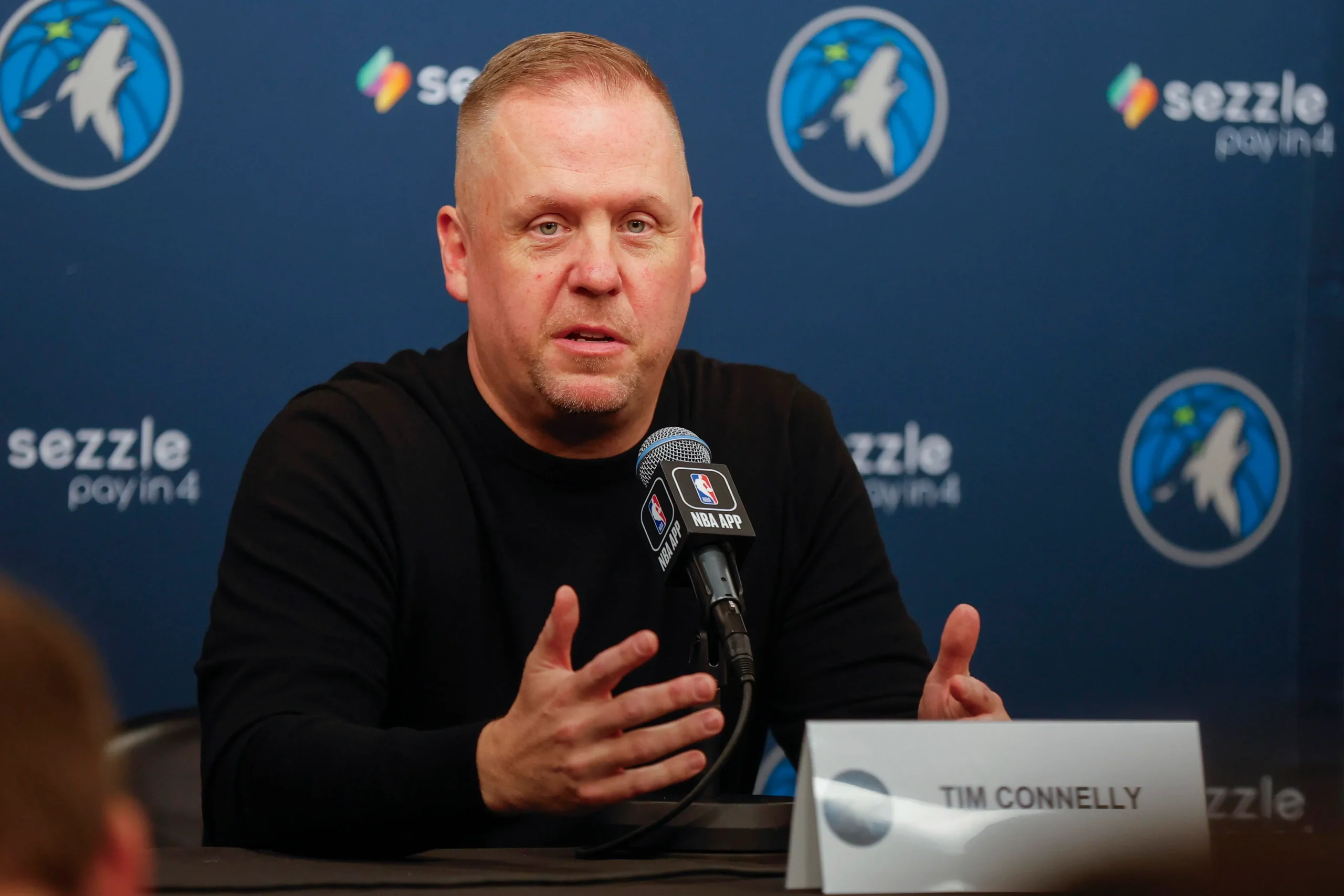
Minnesota Timberwolves President of Basketball Operations Tim Connelly set the tone of his final media availability of the season on May 19 in his very first comments regarding his impressions on the 2025-26 season.
“I think way more good than bad, but look, we were an inconsistent team.” Connelly said “I think our emotional maturity has continued to be a thing that we have to get better at.”
Moments later, he spoke on whether that emotional maturity is something that could be improved internally, or if the Wolves would need a roster change to fix it.
“Well, I think if we can’t improve internally then we don’t have the right people in the building” Connelly admitted. “So I think we have to hold these guys to unbelievably high standards. Hey look, the roster’s not going to be the same. It’s never the same year-to-year. I think moving forward, emotional maturity certainly is something we’ve talked about consistently, and we have these great moments of it.”
Two different comments, two notable mentions of the need for emotional maturity form the President of Basketball Operations. The need for the Wolves to find that maturity seems to be the main goal of the offseason, and it’s not just Connelly who stressed this need — although he was the most direct.
Minnesota Moodiness
A common theme of the Wolves season was the ability for them to rise to the occasion against the league’s best, yet also fall victim to the league’s lottery teams well below Minnesota in the standings. The lack of gameplan execution was cited numerous times after bad losses, which led to the term “moody” being used by head coach Chris Finch to describe the maturity, and at times, weirdness of the Wolves.
It’s a phrase that wasn’t just used this season, over a year ago, on March 20, 2025, Finch described the Wolves as a moody team when spiraling during losses.
“We do have a bit of a moody group in that regard.” Finch stated. “We’ve got to be able to survive our own mistakes a little bit better. I think guys have the propensity to kinda worry a little bit too much about themselves.”
Although Finch doesn’t call it emotional immaturity, the Wolves habit of spiraling, playing down to competition, and focusing on their own statistics over the team’s performance, rings as clear in this quote as it does over a year later in the Wolves’ 2025-26 exit interviews.
Donte DiVincenzo, a well-respected player in the Wolves locker room, also spoke about the Wolves’ moodiness.
“Once you have stuff in the locker room that’s pointing the fingers at one another and stuff, and the guys aren’t connecting in the locker room, you’re not always going to agree on everything,” DiVincenzo said. “It’s 15, 17 players in there. You’re not gonna agree on everything. But when you have good guys, you have hard workers and you have talent, you can figure stuff out and you can tweet things throughout the season. And it just takes that humility to understand that whatever is needed, it needs to be done.”
DiVincenzo continued about the need for the Wolves to play selfless basketball in order to get over the hump and win a championship.
“I would like to say I tried to play selfless basketball all year long, but you have your moments.” DiVincenzo said. “You want points, and you want rebounds, and you want steals. So it’s not easy to be like ‘oh, tonight wasn’t my night, but we won. Let’s go, guys.’ It’s not easy to do that. But we have a good group of guys, I really believe that. I think collectively in the locker room, everybody’s had their moments. But I don’t think it’s something where, in this locker room, we’re pointing the finger at people.”
What was noticeable is the sheer amount of players in exit interviews that acknowledged Finch’s point that the team wasn’t always focusing on the team first. And to a further extent, Connelly’s comments about the team needing more emotional maturity.
“If it’s not your night, just be happy for the next person who’s having a good game or whoever’s stepping up that night,” Jaden McDaniels said. “I feel like that’s the first part, and then just really being together. Like I know we’re all cool, we’re all friends and stuff like that. So it shouldn’t matter who’s having a good game, but I for sure think, if we can get rid of that a little bit, we’ll be way better.”
Naz Reid also echoed the same point when reflecting on the season that was for the Wolves.
“Probably just the moodiness,” he said. “You look at both of those teams and they’re playing for one another, they’re excited to be on the floor with one another, they’re a team where they’re selfless. … I think we have more than enough talent, but just being less moody. I think that’s just the name of the game for us, just being less moody and more selfless.”
The Path Forward
All the quotes combined make the objective crystal clear for Connelly and the Wolves organization: they must find a way to heal a locker room that isn’t necessarily broken, but certainly needs an infusion of emotional maturity to help them better focus collectively on the goal of a championship.
Unfortunately, this is significantly easier said than done. The Wolves are operating on separate timelines that do have different needs and goals. They have Rudy Gobert, Mike Conley, Kyle Anderson and DiVincenzo who are all searching for a championship at all costs as their careers are entering different phases.
They have Julius Randle, who is a multi-time All-Star known for scoring in bunches and his offensive fire power consistently being in trade rumors as he attempted to change his game into a more offensive playmaking role.
Then you have the young guys — Anthony Edwards, McDaniels, Reid, Ayo Dosunmu and Terrence Shannon Jr. — who are all under 26 years old. They are still learning about the NBA and what being a professional basketball consists of, which as Conley acknowledged, just isn’t to the same level of desperation the older veterans feel.
“I do think they’ve grown a lot in understanding a little bit more of the urgency of it, but I still don’t think they’re there. They’re definitely not where I’m at,” Conley said. “When I’m looking at things, I’ve got a different perspective out there playing. … So I have my motivations and I’d love for them to feel that and go out there and play with that same urgency. But time has to pass a little bit for you to really feel that, and unfortunately that’s how this game works. It just takes time for people to really understand it.”
This is where the conundrum of emotional maturity hits home, the Wolves have emotional mature players, but they aren’t necessarily the leaders of the team anymore, whether that’s due to injury or Father Time. Simultaneously, the young core has just not had enough reps and experience to be able to fully understand why the moodiness and immaturity can destroy a team.
As Connelly said, the roster is not going to be the same, but his biggest test will be in how he accomplishes his goal this season. The Wolves need maturity, which could result in them making a major trade to inject that mindset. Or it could lead to a trust fall that the younger players can grow and manage a locker room in a way that takes time to understand.
Either way, the risks involved could shape the future of the franchise for years to come.